


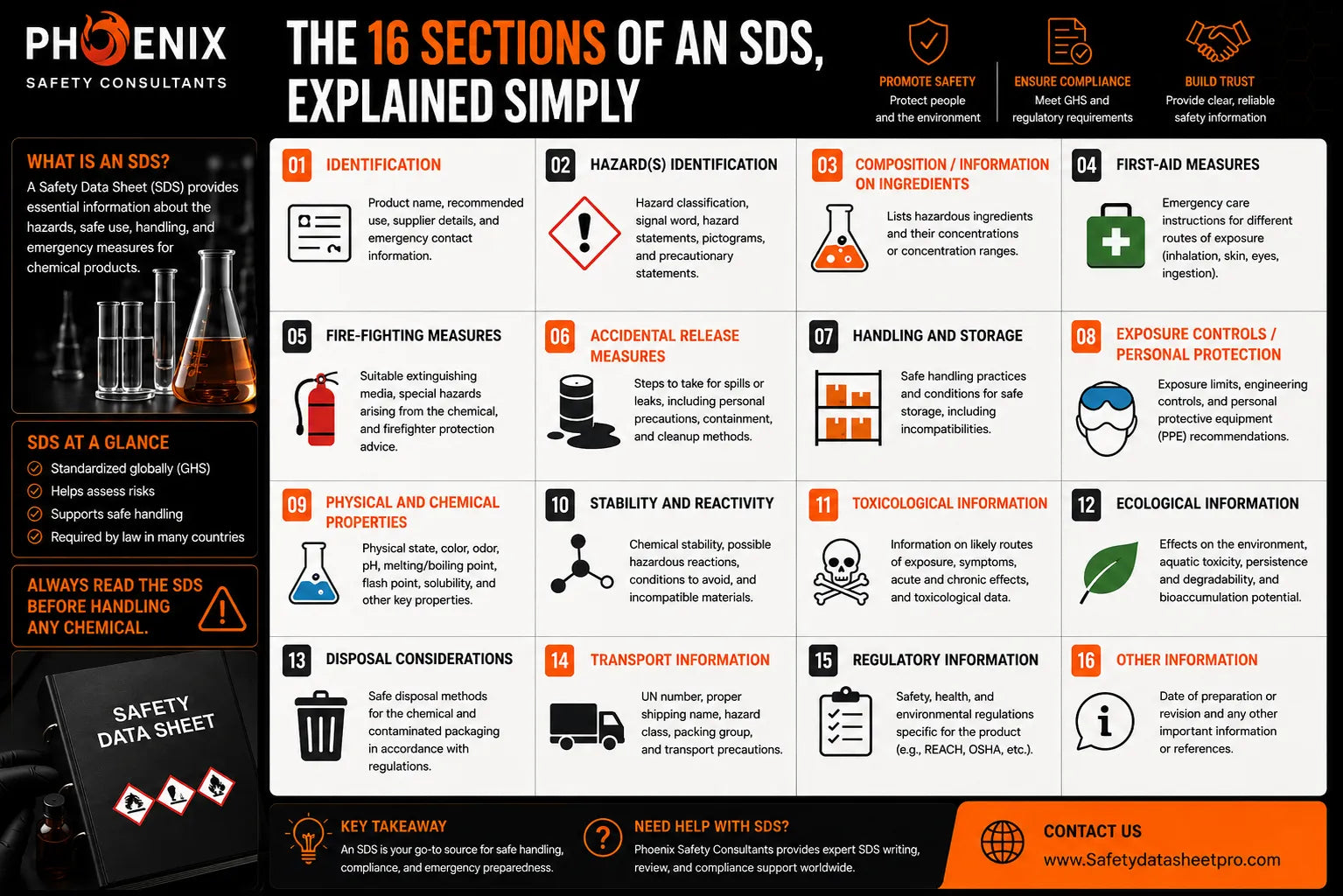
A Safety Data Sheet can look intimidating, pages of technical language, codes, and chemistry. But underneath, every compliant SDS in the world follows the exact same structure: sixteen numbered sections, always in the same order. Once you know what each one is for, the whole document becomes far easier to read, check, and trust.
Here is the short version. An SDS has 16 sections, fixed by the Globally Harmonized System (GHS). The first eight cover the urgent, practical essentials, identity, hazards, ingredients, first aid, fire, spills, handling, and protection, and the rest provide the technical, environmental, transport, and regulatory detail, ending with the document’s revision date in Section 16.
This guide walks through all sixteen sections in plain English, explains what each one contains and why it matters, and points out the handful of sections that sellers most need to get right. Whether you are checking a supplier’s sheet or trying to understand your own, this is the map.
Why Every SDS Has the Same 16 Sections
The standardized structure exists for a simple reason: in an emergency, no one should have to hunt through an unfamiliar document to find what they need. Before the modern SDS, the older MSDS format had no fixed layout, so every manufacturer organized theirs differently, wasting precious time exactly when speed matters most.
The Globally Harmonized System fixed that by locking the document into sixteen sections in a set order, adopted worldwide and, in the US, through OSHA’s Hazard Communication Standard. Now a warehouse worker, a firefighter, a customs officer, or an Amazon reviewer can open any SDS and know exactly where to look. That predictability is the whole point, and it is why a sheet that does not follow the structure is treated as non-compliant.
A Quick History: From MSDS to the 16-Section SDS
It helps to know how we got here. For decades, the standard hazard document was the Material Safety Data Sheet, or MSDS. There was no required structure, so a sheet from one manufacturer might bury first-aid information in a different place than the next, and comparing two products meant relearning each layout. In an emergency, that inconsistency was genuinely dangerous.
The Globally Harmonized System of Classification and Labelling of Chemicals (GHS) was developed internationally to fix this, standardizing both how hazards are classified and how they are communicated. The United States adopted it through OSHA’s Hazard Communication Standard, which is why the MSDS gave way to the 16-section SDS. The shift was not merely cosmetic: it aligned the US with a global system, so a sheet structured correctly here is recognizable to handlers and regulators around the world. When people still say “MSDS” today, they almost always mean what is now properly called an SDS.
The 16 Sections at a Glance
Here is the full structure in brief, before we walk through each section in detail:
|
Section |
What it covers |
|
1. Identification |
Product name, supplier, emergency contact, recommended use |
|
2. Hazard identification |
GHS hazards, signal word, pictograms, precautionary statements |
|
3. Composition / ingredients |
Hazardous ingredients, CAS numbers, concentrations |
|
4. First-aid measures |
What to do for inhalation, skin, eye, and ingestion exposure |
|
5. Fire-fighting measures |
Suitable extinguishing media and fire hazards |
|
6. Accidental release measures |
Spill and leak containment and cleanup |
|
7. Handling and storage |
Safe handling and storage conditions |
|
8. Exposure controls / PPE |
Exposure limits and protective equipment |
|
9. Physical and chemical properties |
Appearance, odor, flash point, boiling point, and more |
|
10. Stability and reactivity |
Stability, conditions and materials to avoid |
|
11. Toxicological information |
Health effects and routes of exposure |
|
12. Ecological information |
Effects on the environment |
|
13. Disposal considerations |
Safe disposal and waste handling |
|
14. Transport information |
UN number, shipping name, hazard class |
|
15. Regulatory information |
Applicable safety, health, and environmental rules |
|
16. Other information |
Revision date, version, abbreviations |
The 16 Sections Explained
Section 1: Identification
This opening section identifies the product and who stands behind it. It includes the product name or identifier, which, for Amazon, must match your listing, the manufacturer or supplier’s name and contact details, an emergency phone number, and the product’s recommended use and any restrictions. Think of it as the document’s cover page: who, what, and how to reach someone in an emergency.
Section 2: Hazard Identification
Section 2 is the heart of the SDS: it states what is dangerous about the product. It lists the GHS hazard classifications, the signal word (“Danger” or “Warning”), the hazard pictograms, the hazard statements such as “highly flammable liquid,” and the precautionary statements telling people how to stay safe. If you read only one section to understand a product’s risks, this is it.
Section 3: Composition / Information on Ingredients
This section lists the hazardous ingredients in the product, along with their chemical identifiers, such as CAS numbers, and their concentrations or concentration ranges. For mixtures, it names the components that drive the hazards. Where an exact concentration is a genuine trade secret, it may be withheld under specific rules, but the hazardous ingredients themselves still have to be disclosed.
Section 4: First-Aid Measures
Section 4 explains what to do if someone is exposed, broken down by route: inhalation, skin contact, eye contact, and ingestion. It describes immediate first-aid steps, the most important symptoms and effects, and any need for prompt medical attention. It is written so that a non-expert can act quickly in an emergency, without needing to interpret the chemistry.
Section 5: Fire-Fighting Measures
This section tells responders how to fight a fire involving the product: which extinguishing media are suitable and which to avoid, the specific hazards that arise during a fire, such as dangerous decomposition gases, and the protective equipment firefighters should use. For flammable products, it is critical, life-safety information.
Section 6: Accidental Release Measures
Section 6 covers spills and leaks. It sets out the personal precautions and protective equipment to use, how to contain and clean up a release, and the steps needed to protect the environment. In short, it is the playbook for when the product ends up somewhere it should not be.
Section 7: Handling and Storage
This section gives practical guidance for day-to-day safety: precautions for handling the product without incident, and the conditions for storing it safely, including temperature, ventilation, and any materials it must be kept away from. For a warehouse or fulfillment center, this is among the most useful sections in the whole document.
Section 8: Exposure Controls / Personal Protection
Section 8 addresses limiting exposure. It lists any occupational exposure limits, the engineering controls that reduce exposure such as ventilation, and the personal protective equipment, gloves, eye protection, respirators, appropriate for handling the product. It answers the question: how do I work with this safely?
Section 9: Physical and Chemical Properties
This section is the product’s technical profile: appearance, odor, pH, melting and boiling points, flash point, flammability, vapor pressure, density, solubility, and more. For sellers, the flash point here is especially important, because it underpins the flammability classification that so often triggers a hazmat flag on Amazon.
Section 10: Stability and Reactivity
Section 10 describes how the product behaves chemically: whether it is stable, the possibility of hazardous reactions, the conditions to avoid such as heat or moisture, the materials it is incompatible with, and any dangerous decomposition products. It answers the question: under what circumstances could this product become more dangerous than usual?
Section 11: Toxicological Information
This section details the health effects: the routes of exposure, the likely symptoms, and the acute and chronic effects, often with numerical toxicity measures and information on whether ingredients are known to cause issues like irritation, sensitization, or cancer. It is the medical and scientific backbone behind the hazard statements in Section 2.
Section 12: Ecological Information
Section 12 covers the product’s effect on the environment: its toxicity to aquatic life, how persistent or degradable it is, whether it accumulates in organisms, and how it moves through soil. Many products, essential oils among them, carry meaningful environmental hazards that belong here. Under US rules, OSHA requires this section to be present, though its content falls under other agencies’ oversight.
Section 13: Disposal Considerations
This section explains how to dispose of the product and its packaging safely, including any special handling for waste and relevant disposal considerations. It helps ensure the product does not become an environmental or safety problem at the end of its useful life.
Section 14: Transport Information
Section 14 is the shipping section, and it matters enormously for online sellers. It lists the UN number, the proper shipping name, the transport hazard class, the packing group, and any special transport precautions. For battery and flammable products, this is where the dangerous-goods classification that governs how you can ship actually lives.
Section 15: Regulatory Information
This section lists the safety, health, and environmental regulations that apply specifically to the product. It is where country-specific compliance shows up, and a sheet written for the wrong region often reveals itself here, which is one reason a US listing needs an SDS oriented to US rules rather than another country’s.
Section 16: Other Information
The final section records the document’s own details: the date of preparation or last revision, the version number, a key to any abbreviations used, and references. The revision date here is what everyone uses to judge whether the SDS is current, so an SDS with no date in Section 16 is incomplete and likely to be questioned.
Which Sections Sellers Should Pay Most Attention To
You do not need to master all sixteen sections to sell compliantly, but a handful deserve your attention as a seller. Section 1 has to match your listing’s product and brand name exactly, or Amazon may reject the sheet. Section 2 is where your product’s hazards are declared and must be accurate. Section 9’s flash point underpins the flammability classification that triggers so many flags. Section 14 carries the transport and UN details that govern how your product can ship. And Section 16’s revision date determines whether your document is considered current. Get those five right, and you have addressed the points that most often make or break an SDS submission.
How the Sections Work Together
Read in order, the sixteen sections tell a coherent story. The first three identify the product, declare its hazards, and reveal what is inside it. The next five, four through eight, are the urgent, practical core: what to do in an emergency, how to fight a fire, how to clean a spill, how to handle and store it, and how to protect the people working with it. Sections nine through eleven provide the technical and scientific backing, the physical properties, the chemistry, and the health effects. And the final five cover the environment, disposal, transport, regulations, and the document’s own housekeeping. The order is deliberate: the information you would need fastest in an emergency comes first.
Common Problems, Section by Section
Knowing the structure also helps you spot a weak SDS. The most common problems cluster in a few sections: a Section 1 product name that does not match the listing, vague or missing ingredients in Section 3, a blank flash point in Section 9, an empty or incorrect transport entry in Section 14, regulatory information in Section 15 written for the wrong country, and, very commonly, a missing revision date in Section 16. When an SDS is rejected, the cause is almost always traceable to one of these specific sections, which makes the document far easier to diagnose and fix once you know where to look.
How to Use the 16 Sections to Check a Supplier's SDS
Now that you know what each section should contain, you have a practical tool: a way to sanity-check any sheet a supplier hands you before you rely on it. Open the document and run down the structure. Does Section 1 name your product and brand, or the factory’s? Does Section 2 actually declare hazards, or is it suspiciously blank for a product you know is flammable? Does Section 3 list real ingredients with CAS numbers? Is there a flash point in Section 9? Does Section 14 carry a transport classification if the product needs one? Does Section 15 reference the right country’s rules? And is there a revision date in Section 16, dated within the last few years?
A sheet that passes all of those checks is probably usable. One that fails several, common with generic supplier documents, is a signal that it needs reauthoring or reformatting before you submit it anywhere. The 16-section structure turns “I’m not sure if this is any good” into a clear, repeatable inspection you can run in a couple of minutes.
|
Want an SDS that gets all sixteen sections right? We author complete, US OSHA-compliant Safety Data Sheets, every section accurate and matched to your listing, so your document holds up in review the first time. Tell us about your product and we’ll handle the rest. |
Frequently Asked Questions
How many sections does an SDS have?
Sixteen, always in the same fixed order set by the Globally Harmonized System (GHS). A document that does not follow this 16-section structure is not a compliant SDS, which is one reason older MSDS-format sheets get rejected.
Are all 16 sections required?
Yes, all sixteen must be present and in order. In the US, OSHA enforces the content of sections 1 through 11 and 16, while sections 12 through 15 must still appear but their content falls under other agencies, such as the DOT for transport and the EPA for environmental matters.
What is the most important section of an SDS?
Section 2, Hazard Identification, is the heart of the document because it declares what is dangerous about the product. For sellers specifically, sections 1, 9, 14, and 16 also matter a great deal, since they cover product identity, flash point, transport, and the revision date.
What is the difference between an SDS and an MSDS?
The MSDS was the older format, with no standardized structure, so layouts varied by manufacturer. The modern SDS uses the fixed 16-section GHS structure, which is what current regulations and marketplaces expect.
Where is the date on an SDS?
In Section 16, Other Information. It shows the date of preparation or last revision, and that date is what determines whether the document is considered current.
Do I need to write all 16 sections myself?
You can, and the structure is public, but the difficulty is not the layout; it is classifying the hazards correctly and filling each section with accurate data. Because errors in key sections cause rejections and liability, many sellers have the SDS authored professionally.
Can sections be left blank or marked 'not applicable'?
Every section must be present, but where specific information genuinely does not apply or is unavailable, the SDS should say so explicitly rather than leave a blank. A truly empty required field, such as a missing flash point on a flammable product, reads as incomplete and is a common reason for rejection.
The Bottom Line
The sixteen sections of an SDS only look complicated until you see the logic behind them. They move from identification and hazards, through the urgent practical measures, into the technical and scientific detail, and finish with transport, regulations, and the all-important revision date. Every compliant sheet in the world follows this same map, which is exactly what makes the format so useful.
For a seller, the takeaway is twofold: you can now read and sanity-check any SDS by knowing what each section should contain, and you know which sections, identity, hazards, flash point, transport, and date, most need to be right. A document that gets all sixteen sections accurate and current is one that clears review, satisfies buyers, and actually does its job of keeping people safe.
Need a complete, 16-section compliant SDS? Get your SDS authored here or ask us about your product — we’ll make sure every section is accurate and matched to your listing.