


Amazon flagged your product and now wants documentation. You have heard two terms thrown around, Safety Data Sheet and exemption sheet, and they sound almost interchangeable. They are not. Choosing the wrong one is one of the most common reasons sellers lose days, sometimes weeks, getting a listing approved.
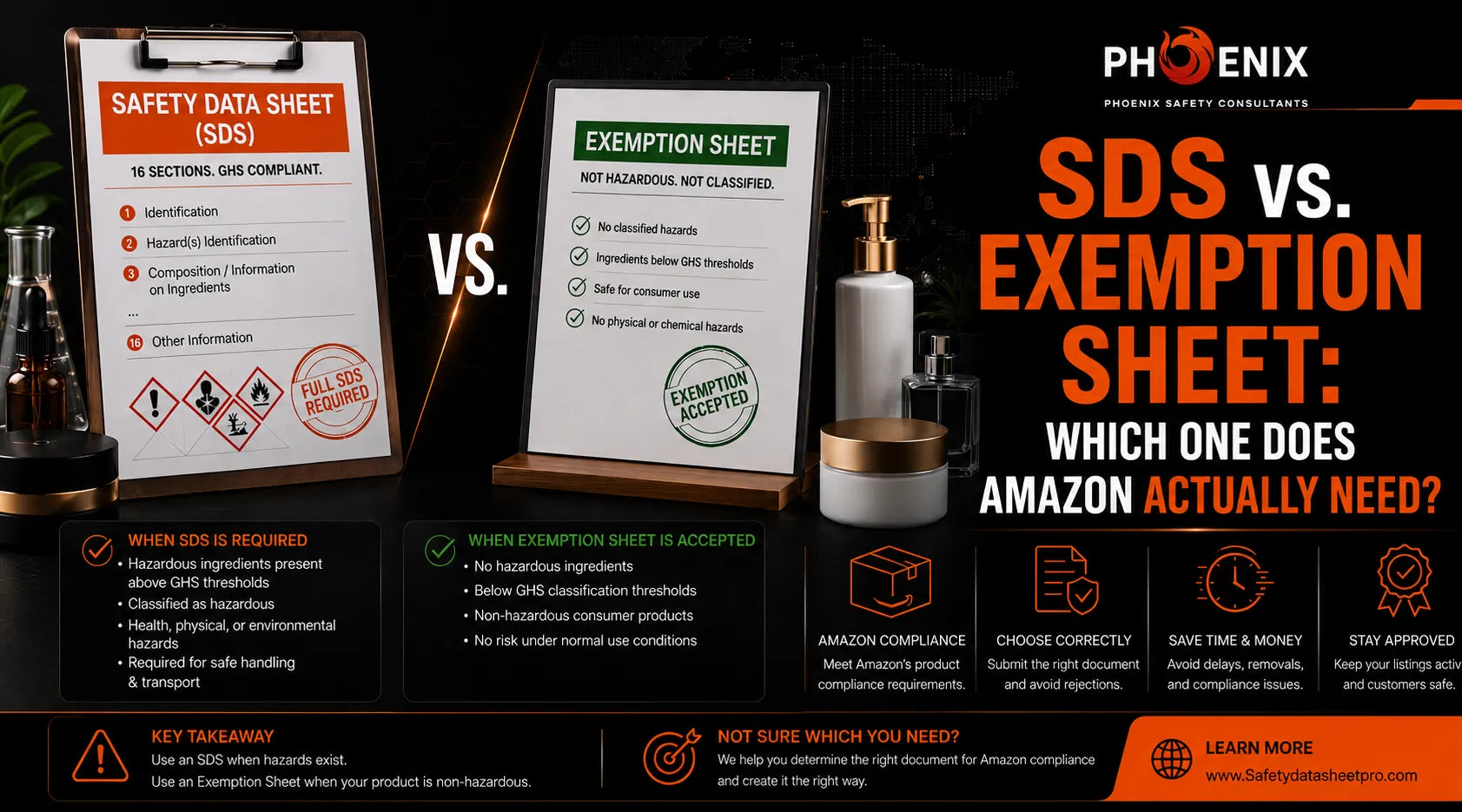
Here is the quick answer. If your product contains hazardous materials, such as chemicals, batteries, flammables, or aerosols, you need a Safety Data Sheet (SDS). If your product contains nothing hazardous but Amazon flagged it anyway, you need an exemption sheet, a short declaration confirming there is nothing dangerous inside. One document describes hazards; the other certifies their absence.
That distinction sounds simple, and for many products it is. But the edge cases are where sellers get burned, and the cost of guessing wrong is real. This guide breaks down exactly what each document is, how they differ, how to tell which one your product needs, how to create and submit an exemption sheet, and the quiet mistakes that cost sellers their launch windows.
The Quick Answer (Your Decision in 30 Seconds)
Before we go deep, here is the rule that resolves most cases. Ask one question: does my product actually contain anything hazardous, including a battery? If the honest answer is yes, you need an SDS, full stop. If the honest answer is no, and Amazon flagged it anyway, an exemption sheet is almost certainly what clears it.
The reason this matters is that Amazon’s classification system is cautious by design. It flags far more products than are truly dangerous, which means a large share of “hazmat” flags actually resolve with a simple exemption sheet rather than a full safety document. Knowing that up front saves you from chasing paperwork you do not need, or worse, certifying something you should not.
Why Amazon Flags So Many Harmless Products
It helps to understand why you keep getting flagged for products that obviously are not dangerous. Amazon’s Dangerous Goods classification leans on automated signals: your product category, keywords in your title and description, the materials you declared, and patterns from similar items. The system is deliberately tuned to over-flag rather than under-flag, because the cost of missing a genuinely hazardous item, a leaking battery or a flammable aerosol sitting in a warehouse, is far higher than the cost of asking a seller for an unnecessary exemption sheet.
That design has a direct consequence for you. A single word like “spray,” “oil,” “charger,” or “scented” in your listing can be enough to trigger a review even when the product itself is completely inert. So can simply belonging to a category that usually contains hazardous items. None of this means your product is actually dangerous; it means the filter is intentionally broad. Once you understand that a flag is often precautionary, the exemption sheet stops feeling like an accusation and starts looking like what it really is, a routine confirmation that clears a false positive.
What Is a Safety Data Sheet (SDS)?
A Safety Data Sheet is the formal hazard document for a product. It follows the Globally Harmonized System (GHS), an international standard that organizes the information into a fixed 16-section layout so anyone, anywhere, can find what they need quickly.
What an SDS Contains
Across its sixteen sections, an SDS identifies the product, lists hazardous ingredients, classifies the hazards using standardized categories and pictograms, and explains first-aid, firefighting, safe handling, storage, transport, and disposal. In short, it is a complete safety profile. It does not just say “this product is hazardous”; it explains exactly how and what to do about it.
When Amazon Requires an SDS
Amazon requires an SDS whenever a product genuinely qualifies as a dangerous good. That includes anything with a lithium battery, cosmetics and personal-care items with regulated ingredients, cleaning chemicals, essential and fragrance oils, aerosols, flammable goods, paints and adhesives, and automotive fluids. If your product belongs in any of these groups, an exemption sheet will not be accepted, because the product is, by definition, not exempt.
What Is an Exemption Sheet?
An exemption sheet is the document that often gets overlooked, yet it resolves a huge share of Amazon hazmat flags. Understanding it properly is the single most useful thing you can take from this guide.
What an Exemption Sheet Actually States
An exemption sheet is a short, signed declaration in which you, the seller, confirm that your product does not contain hazardous materials and therefore does not require a Safety Data Sheet. It is not a safety analysis. It is a formal statement of fact: there are no regulated chemicals, no batteries, nothing that would classify this item as a dangerous good. Amazon provides a standard exemption sheet template inside Seller Central so the format is consistent.
What Information Goes on It
An exemption sheet is deliberately simple. It typically asks for the identifying and confirming details Amazon needs to clear the product:
- Your product’s ASIN and the marketplace it applies to.
- The product name as it appears on your listing.
- A declaration that the product contains no hazardous materials or batteries.
- Acknowledgment of any required warning-label statements.
- Your details and signature as the responsible seller.
When an Exemption Sheet Is the Right Call
Reach for an exemption sheet when Amazon has flagged a product that genuinely contains nothing hazardous. This happens constantly, because the classification system errs heavily toward caution. A plain phone case, a cotton garment, a stainless-steel water bottle, a wooden toy with no battery, a silicone kitchen tool, any of these can get pulled into a Dangerous Goods review despite being completely benign. In those cases, an exemption sheet is the correct, fast, and free way to clear it.
SDS vs. Exemption Sheet: The Key Differences
The two documents serve opposite purposes. One proves a product is safe to handle by describing its hazards; the other certifies that no hazards exist. Here is how they compare at a glance:
|
|
Safety Data Sheet (SDS) |
Exemption Sheet |
|
What it does |
Documents the product’s hazards and safe handling |
Declares the product has no hazardous materials |
|
When to use it |
Product contains chemicals, batteries, or regulated materials |
Product was flagged but contains nothing hazardous |
|
Format |
Standardized 16-section GHS document |
Short signed declaration (Amazon template) |
|
Who prepares it |
Authored from product data, often by a professional |
Self-declared by the seller |
|
Effort required |
Hazard classification and ingredient data needed |
Minimal: fill in product and ASIN details |
|
Risk if wrong |
Rarely an issue when accurate |
Falsely certifying a hazardous item risks rejection and liability |
How to Tell Which One Your Product Needs
Most of the time the choice is obvious. When it is not, work through the following in order.
The Hazardous-Materials Test
Start with the substance of the product, not how it looks. Does it contain a battery of any kind? Any chemical, solvent, acid, or base? Anything flammable, pressurized, corrosive, oxidizing, or toxic? If you can point to even one such component, you are in SDS territory. The presence of a single lithium cell is enough on its own.
Products That Always Need an SDS
If your item falls into these groups, do not bother with an exemption sheet, because it will be rejected: anything battery-powered, cosmetics and fragrances, cleaning and disinfecting products, essential oils, aerosols and sprays, candles and other flammables, paints, glues and resins, and automotive chemicals. These are dangerous goods by definition.
Products That Usually Qualify for an Exemption Sheet
On the other side, items made entirely of inert materials with no battery and no chemical content are typical exemption-sheet candidates: textiles, plain plastics and silicone, untreated wood, glass, ceramics, and most simple metal goods. If Amazon flagged one of these, it is usually a precautionary catch rather than a real hazard.
The Gray Area: When You Are Not Sure
Some products sit in between. A scented item might or might not cross a flammability threshold. A “battery-free” gadget might include a small button cell you forgot about. A cosmetic might contain an ingredient that is regulated above a certain concentration. When you are genuinely unsure, do not guess on a self-declaration, because the exemption sheet makes you personally responsible for the claim. This is the moment to check your ingredient or component data carefully, or to ask a compliance professional which document applies. A short conversation is far cheaper than a rejected listing or a liability problem.
Real Examples: Which Document Each Product Needs
Abstract rules click into place with concrete cases. Here are common products and the document each one actually needs:
- A stainless-steel water bottle flagged during review. No battery, no chemicals, fully inert. Exemption sheet.
- A scented soy candle. Wax and fragrance load make it flammable, so it is a dangerous good. SDS.
- A wireless mouse. The lithium button cell alone makes it hazmat, even though the device feels harmless. SDS.
- A cotton t-shirt pulled into a Dangerous Goods review by mistake. Nothing regulated inside. Exemption sheet.
- A bottle of essential oil. Flammable and skin-sensitizing. SDS, every time.
- A silicone phone case. Inert material, no battery. Exemption sheet.
- Hand sanitizer. High alcohol content makes it flammable. SDS.
- A plain wooden puzzle with no coating and no battery. Inert. Exemption sheet.
Notice the pattern. The deciding factor is never how dangerous the product feels in your hand; it is whether it contains a regulated substance or a battery. Two products that look equally harmless on a shelf can need opposite documents, which is exactly why a careful look at what is actually inside beats a gut reaction every time.
How to Create and Submit an Exemption Sheet
If you have determined an exemption sheet is correct, the process is quick. The exact screens in Seller Central change from time to time, but the flow is consistent:
- Download Amazon’s exemption sheet template from the dangerous-goods or compliance section of Seller Central.
- Fill in the required fields, including the ASIN, product name, and marketplace, and complete the declaration confirming the product contains no hazardous materials.
- Acknowledge any warning-label statements the template asks for.
- Save the completed sheet as a clear file within Amazon’s size limit (commonly up to 20 MB).
- Upload it through the Manage Dangerous Goods Classification tool, selecting the correct ASIN, marketplace, and language, then submit.
- Repeat for each ASIN that has been flagged, since exemption applies per product.
Once submitted, the document enters the same Dangerous Goods review queue as an SDS, and Amazon’s team evaluates it, typically within a few business days.
Common Mistakes (and What They Cost You)
Using an Exemption Sheet for a Hazardous Product
The most expensive mistake is trying to slip a genuinely hazardous product through with an exemption sheet to avoid the cost or effort of an SDS. Amazon’s team is reviewing exactly this, so the document gets rejected, your 14-day clock resets, and repeated attempts can flag your account for closer scrutiny. You do not save money by declaring a battery-powered product exempt; you lose weeks.
Hunting for an SDS You Do Not Need
The opposite mistake is just as common and almost as costly in time. A seller with a completely inert product panics at the word “hazmat,” spends days emailing suppliers for a Safety Data Sheet that does not exist and was never needed, and lets the deadline tick down, when a five-minute exemption sheet would have cleared the listing. Identify the right document first, and you avoid both traps.
Treating a Self-Declaration Casually
An exemption sheet is a legal declaration with your name on it. If you certify that a product is non-hazardous and it turns out not to be, the responsibility sits with you, not with Amazon. That is not a reason to fear the document; it is a reason to make sure your claim is actually true before you sign it. When in doubt, verify your ingredients or components rather than assuming.
What Happens After You Submit
The Review Timeline
Whether you submit an SDS or an exemption sheet, it goes into Amazon’s Dangerous Goods review. A complete, correct document is usually processed within roughly two to five business days. Submitting documentation proactively when you first create a listing, rather than waiting to be flagged, can speed this up and sometimes prevents a borderline product from being classified as hazmat in the first place.
If Your Document Is Rejected
If a submission bounces, read the reason carefully before resubmitting. For an exemption sheet, rejection usually means Amazon believes the product does contain a regulated material, which is a signal that you may actually need an SDS after all. For an SDS, rejection is typically a format, country, or product-name issue. Either way, resubmitting the same document unchanged will not work; identify the gap, fix it, and submit the correct version once.
How to Avoid Triggering a Second Review
One practical tip can save you from repeating this whole process. After your product is classified, significantly changing the listing, its title, bullet points, images, or declared materials, can send the ASIN back through Dangerous Goods classification, and you may be asked for documentation all over again. Keep your catalog data consistent with the document you filed, and only edit what you genuinely need to. Stability in your listing is quietly one of the easiest ways to stay out of the review queue.
|
Not sure whether your product needs an SDS or just an exemption sheet? Send us the product details and we’ll confirm which document applies, and if it’s an SDS, we’ll author an Amazon-ready one matched to your listing, often within 24 hours. |
Frequently Asked Questions
Is an exemption sheet the same as an SDS?
No. They are opposites. An SDS documents a product’s hazards and how to handle them safely, while an exemption sheet declares that a product has no hazards and therefore needs no SDS. You submit one or the other, depending on whether your product is actually hazardous.
Can I write my own exemption sheet?
Yes. An exemption sheet is a self-declaration, and Amazon provides a standard template in Seller Central. The catch is that you are personally responsible for the accuracy of the claim, so only use one when you are certain the product contains nothing hazardous.
My supplier gave me an SDS, but my product seems harmless. Which do I submit?
If the product genuinely contains a regulated material, submit the SDS even if it feels low-risk. If the SDS was sent in error and the product is truly inert, an exemption sheet may be appropriate. When the two signals conflict, verify the actual contents before deciding.
Does an exemption sheet cost anything?
No. Filing an exemption sheet is free; it is simply a declaration you complete and upload. The only cost is the time to confirm your product really is non-hazardous. A full SDS, by contrast, requires authoring and so has a cost attached.
How long is an exemption sheet valid?
It applies to the specific product and listing you submit it for. If you change the product’s formulation, components, or add a battery, the earlier declaration no longer holds and the item may need reclassification or an SDS.
What if Amazon rejects my exemption sheet?
A rejection usually means Amazon’s team believes the product contains a regulated material. Rather than resubmitting the same sheet, treat it as a sign to check your components again; you may actually need a Safety Data Sheet for that item.
Can one document cover several products?
Generally no. Both an SDS and an exemption sheet are tied to a specific product and ASIN. A variation pack or a bundle may need documentation for each component, and every flagged ASIN is reviewed on its own, so plan to prepare a document per product rather than one catch-all sheet.
The Bottom Line
The choice between an SDS and an exemption sheet comes down to one honest question: does your product actually contain anything hazardous? If yes, you need a Safety Data Sheet, properly authored for your marketplace and matched to your listing. If no, and Amazon flagged it out of caution, an exemption sheet is the fast, free way to clear it. The sellers who breeze through Dangerous Goods review are simply the ones who answer that question accurately on day one and submit the right document, done correctly, the first time.
Get the diagnosis right, and the paperwork stops being a roadblock and becomes a five-minute step in your launch.
Stuck deciding, or need an SDS authored fast? Get your Amazon-ready document here or contact us for a quick answer — we’ll tell you exactly which one your product needs.