


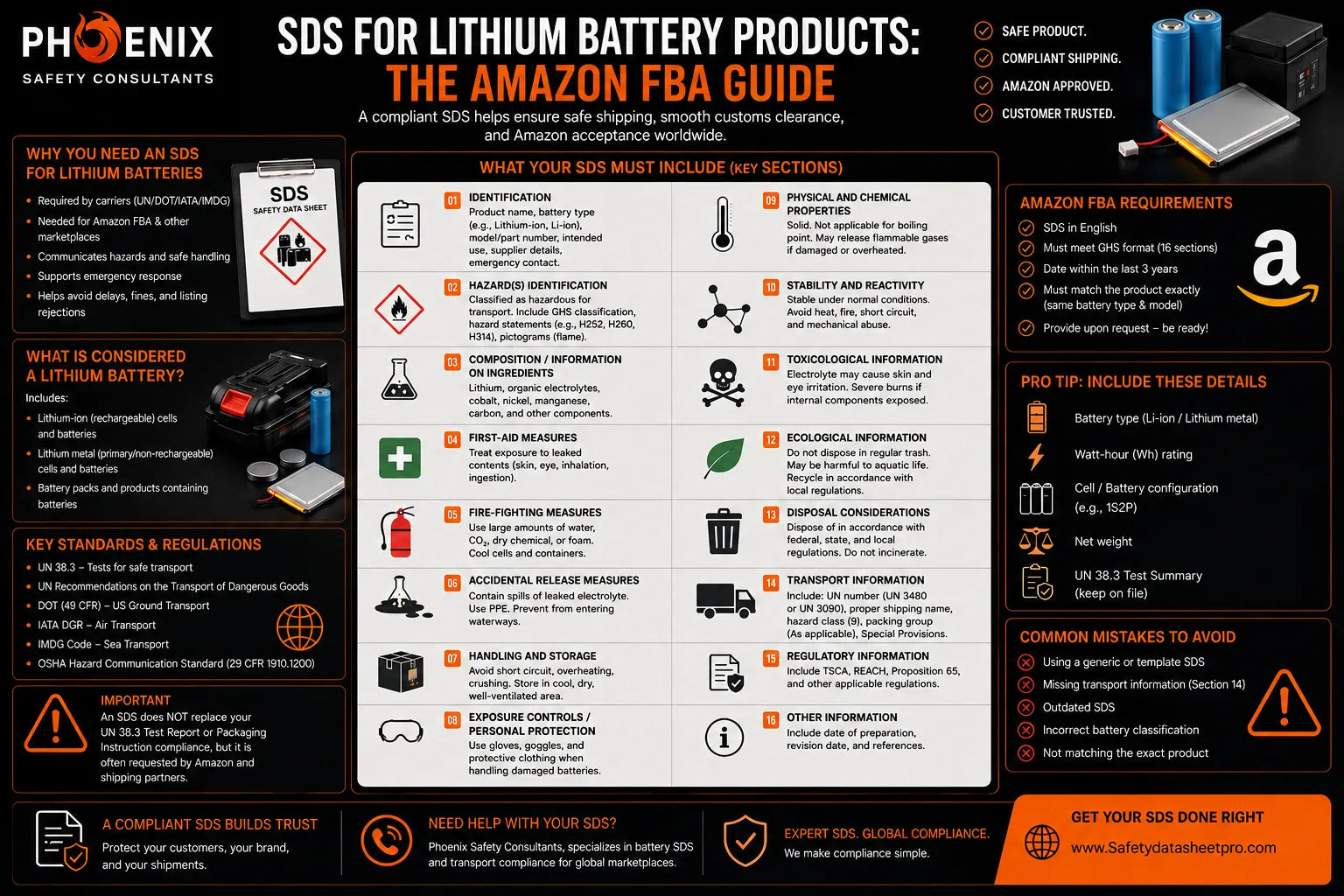
If there is one thing guaranteed to get your Amazon listing flagged as a dangerous good, it is a battery. Lithium batteries are the single most common FBA hazmat trigger, and the net is wide: not just loose cells and power banks, but anything with a battery built in, from wireless earbuds to a child’s toy to a gadget you never think of as “hazardous.”
Here is the short answer. Lithium battery products almost always need a Safety Data Sheet to sell on Amazon, and for shipping the batteries you will usually also need a separate document called a UN 38.3 test summary. These two are not the same thing, and confusing them is one of the most common and costly mistakes battery sellers make.
This guide explains why lithium batteries are treated as dangerous goods, the crucial difference between the SDS and the UN 38.3 test summary, the UN numbers that classify your product, what a battery SDS must contain, and how to get compliant so your battery listing actually goes live.
Do Lithium Battery Products Need an SDS for Amazon?
In practice, yes. While a sealed battery can technically be considered an “article” that does not always require an SDS under strict workplace rules, Amazon’s Dangerous Goods program routinely requests one for battery-containing products, and cell and battery manufacturers almost always issue an SDS anyway. So for a seller, the realistic expectation is simple: if your product contains a lithium battery of any kind, plan on needing an SDS.
The trigger is broad. It is not only products that are obviously “batteries,” such as power banks or replacement cells. A device with a built-in rechargeable battery, a toy with a coin cell, a gadget bundled with a battery, even a small accessory, can all be flagged. The presence of the battery is what matters, not how central it is to the product. If there is a lithium cell inside, assume Amazon will ask.
SDS vs. UN 38.3 Test Summary: The Two Documents Battery Sellers Confuse
This is the distinction that trips up almost every new battery seller, so it is worth being precise. They are two different documents that do two different jobs, and you often need both.
The Safety Data Sheet (SDS) is a hazard-communication document. It describes the battery’s hazards, chemistry, and safe handling, storage, transport, and emergency response, in the standard 16-section format. It is what Amazon typically asks for in a Dangerous Goods review.
The UN 38.3 test summary is a transport-safety document. It is a summary of the results of a specific series of tests, from the UN Manual of Tests and Criteria, section 38.3, that lithium batteries must pass before they can be shipped: altitude simulation, thermal cycling, vibration, shock, short circuit, and more. It proves the battery itself has been tested and is safe to transport, and it is required by air, sea, and road carriers for lithium batteries.
In short: the SDS communicates the hazards; the UN 38.3 test summary proves the battery passed its transport tests. Amazon and your freight forwarders may ask for either or both, so battery sellers should be ready to provide each. This guide focuses on the SDS, but do not assume one document covers the other.
Why Lithium Batteries Are Treated as Dangerous Goods
Fire and Thermal Runaway Risk
Lithium batteries store a lot of energy in a small space, and when they fail, through damage, a manufacturing defect, overcharging, or a short circuit, they can overheat, catch fire, or enter “thermal runaway,” a self-sustaining reaction that is hard to extinguish. That risk is exactly why they are tightly regulated for storage and transport, and why a warehouse full of them needs to know precisely what it is handling. The SDS exists to communicate that.
Lithium-Ion vs. Lithium-Metal
There are two broad families, and the distinction matters. Lithium-ion batteries are the rechargeable cells in phones, power banks, earbuds, and most electronics. Lithium-metal batteries are typically non-rechargeable, including the coin and button cells in watches, remotes, and small devices. They are classified, rated, and shipped differently, so your documentation has to identify which one your product contains.
Watt-Hours and Lithium Content: The Numbers That Matter
Two figures drive a lithium battery’s classification. For lithium-ion, it is the watt-hour (Wh) rating, a measure of energy capacity. For lithium-metal, it is the lithium content, measured in grams. These numbers determine which shipping category the battery falls into and what limits and packaging apply, with most consumer electronics sitting under common thresholds that allow shipment with the right documentation and packaging. Because of this, the watt-hour rating or lithium content is essential information on your SDS and for any transport paperwork, and a sheet that omits it is incomplete.
Which Battery Products Get Flagged
Almost anything containing a lithium cell can be flagged. The table below shows common products, their typical battery type, and the documentation sellers usually need. Treat it as a guide; the exact requirements depend on the chemistry and configuration:
|
Product |
Typical battery |
Documentation usually needed |
|
Power bank / portable charger |
Lithium-ion |
SDS + UN 38.3 test summary |
|
Wireless earbuds, headphones |
Lithium-ion (small) |
SDS + UN 38.3 test summary |
|
Toy or gadget with built-in battery |
Li-ion or li-metal |
SDS + UN 38.3 test summary |
|
Device sold with a separate battery |
Lithium-ion |
SDS + UN 38.3 (in/with equipment) |
|
Loose replacement batteries or cells |
Li-ion or li-metal |
SDS + UN 38.3; strict shipping limits |
|
Button / coin-cell product (watch, remote) |
Lithium-metal coin cell |
SDS + UN 38.3 test summary |
|
Product where the battery is a minor add-on |
Small li-ion or alkaline |
SDS often still required |
Understanding the UN Numbers (UN3480, UN3481, UN3090, UN3091)
When you ship lithium batteries, they are assigned one of four UN numbers, and which one applies to your product affects packaging, labeling, and documentation. They split along two lines: chemistry (ion vs. metal) and configuration (alone, or packed with or inside equipment).
- UN3480 — lithium-ion batteries shipped on their own.
- UN3481 — lithium-ion batteries packed with, or contained in, equipment.
- UN3090 — lithium-metal batteries shipped on their own.
- UN3091 — lithium-metal batteries packed with, or contained in, equipment.
So a power bank sold alone and the same cell built into a device fall under different UN numbers, with different rules. Your documentation needs to reflect the correct one, which is another reason the battery chemistry and configuration have to be stated accurately.
Are There Battery Products That Don't Need an SDS?
Not every battery automatically triggers the same requirements, and a few cases are worth knowing. Standard non-lithium batteries, such as ordinary alkaline AAs, are far less regulated than lithium cells and may not draw the same dangerous-goods treatment, though Amazon can still flag a product and ask you to confirm. Products designed to ship without the battery installed, where the buyer adds their own, change the picture too, since the hazardous component is not in the box.
That said, do not assume your way out of it. Amazon’s system flags broadly and cautiously, so even a low-risk battery product can be pulled into review, and the answer there may be an exemption sheet rather than a full SDS, or it may be that the lithium content genuinely requires one. As with every category, the safe move is to confirm against the actual product, its battery chemistry, and how it ships, rather than guessing that “it’s just a small battery, so it must be fine.”
What a Lithium Battery SDS Must Include
Battery Chemistry and Specifications
A battery SDS must identify the chemistry, lithium-ion or lithium-metal, and the key specifications: the watt-hour rating for lithium-ion, the lithium content in grams for lithium-metal, the cell and battery configuration, and the relevant UN number. These details are not optional extras; they are the information everyone downstream needs to handle and ship the product correctly.
Correct Hazard Classification
The document must classify the hazards accurately, including the fire and thermal hazards specific to lithium batteries, and present the right signal words, hazard statements, and pictograms. A battery SDS that treats the product as a generic, low-hazard item misses the entire point and will not satisfy a Dangerous Goods review.
Handling, Storage, Transport, and Emergency Information
Because the real risks with batteries are fire and thermal runaway, the SDS should give meaningful guidance on safe handling and storage, what to do in case of damage or a short circuit, firefighting measures appropriate to a lithium fire, and transport considerations. This is the content that makes the document genuinely useful to a warehouse or a first responder, not just a box-ticking exercise.
US OSHA Format Matched to Your Listing
For Amazon US, the SDS must follow the OSHA Hazard Communication Standard, be in English, use the 16-section GHS format, and match your product and brand. A cell-manufacturer SDS written for the raw battery in another country, under another name, frequently fails on these points even though it contains good technical data.
Other Documents You May Need for Battery Products
Beyond the SDS, battery sellers often need additional paperwork, and it helps to know what may come up so nothing surprises you mid-launch:
- UN 38.3 test summary — the transport-test document described earlier, frequently requested for the batteries themselves.
- Proper packaging and labeling — lithium batteries require specific dangerous-goods packaging and hazard labels for shipment.
- The cell or battery manufacturer’s documentation — useful source data for both your SDS and your UN 38.3 summary.
- Enrollment in Amazon’s Dangerous Goods program — battery products classified as restricted are handled through this program, which may involve a waitlist.
You will not always need every item, but battery products are documentation-heavy compared with most categories, so it pays to plan for more than just the SDS.
Why Supplier Battery SDS Often Fall Short
Battery cell manufacturers usually do produce an SDS, and you may receive one from your supplier, but it frequently will not pass as-is. The common gaps: it describes the bare cell rather than your finished product, it is written for the manufacturer’s country instead of the US, it carries their company name rather than your brand, or it is missing the specifications and UN number Amazon wants to see. As with any product, the supplier’s document is a valuable source of technical data, but it usually needs to be reauthored or reformatted to match your actual product and the US market.
How to Get a Compliant Battery SDS
If you sell battery products, here is the sequence that produces a document Amazon will accept:
- Identify the battery chemistry (lithium-ion or lithium-metal) and configuration (alone, with, or in equipment).
- Gather the key specifications, the watt-hour rating or lithium content, cell and battery details, and the relevant UN number.
- Collect the cell or battery manufacturer’s documentation, including any existing SDS and UN 38.3 test summary.
- Have the SDS authored to US OSHA and GHS standards, with the battery specifications and hazards classified correctly and matched to your listing.
- Confirm what else you need, such as the UN 38.3 summary and Dangerous Goods program enrollment, for shipping.
- Submit the SDS through Seller Central and keep all battery documentation on file.
Beyond Amazon: Shipping Lithium Batteries Anywhere
Amazon is where most sellers first hit battery documentation, but the requirements follow the product everywhere it moves. Air, sea, and road carriers all regulate lithium batteries under international transport rules, and they expect proper classification, packaging, labeling, and documentation, including the SDS and UN 38.3 test summary, before they will accept a shipment. Air transport in particular is strict, with tight limits on lithium batteries.
Customs and freight forwarders apply the same expectations when your goods cross borders, and wholesale or retail buyers will ask for current battery documentation before stocking your product. So the work you do to satisfy Amazon is not wasted effort for one channel; it is the documentation that lets your battery product move through the supply chain at all. Getting it right once means your product can ship, sell, and clear customs wherever you take it, instead of being held up at each new step for paperwork you could have prepared in advance.
Common Mistakes Battery Sellers Make
A few recurring errors account for most stalled battery listings:
- Confusing the SDS with the UN 38.3 test summary, and assuming one document satisfies a request for the other.
- Forgetting the battery entirely because it is built into a product that does not feel like a “battery item.”
- Submitting a cell-manufacturer SDS for the bare cell instead of one matched to the finished product and brand.
- Omitting the watt-hour rating, lithium content, or UN number, which leaves the document incomplete.
- Underestimating the documentation load, and not budgeting time for the SDS, the UN 38.3 summary, packaging, and program enrollment together.
Battery products simply carry more compliance weight than most categories. Treating that as expected, rather than as a surprise, is what keeps a launch on schedule.
|
Selling power banks, electronics, or anything with a lithium battery? We author US OSHA-compliant battery SDS with the correct chemistry, watt-hour rating, UN number, and hazard classification, matched to your listing, and we can guide you on the other documents battery products need. 24-hour rush available. |
Frequently Asked Questions
Do lithium battery products need an SDS for Amazon?
In practice, yes. Although a sealed battery can technically be treated as an article, Amazon routinely requests an SDS for battery-containing products and manufacturers usually issue one. If your product contains a lithium cell of any kind, plan on needing an SDS.
What is the difference between an SDS and a UN 38.3 test summary?
The SDS is a hazard-communication document describing the battery’s hazards and safe handling. The UN 38.3 test summary is a transport document proving the battery passed a required series of safety tests. They are different, and battery sellers often need both.
Does a product with a small built-in battery still need an SDS?
Often, yes. Amazon’s flag is triggered by the presence of a lithium battery, not by how central it is to the product. A device with a tiny built-in cell, or even a coin-cell accessory, can be flagged just like a power bank.
What are UN3480, UN3481, UN3090, and UN3091?
They are the four UN numbers for lithium batteries. UN3480 and UN3481 cover lithium-ion batteries shipped alone or with/in equipment, while UN3090 and UN3091 cover lithium-metal batteries in the same two configurations. The correct one depends on your battery’s chemistry and how it is packed.
Can I use the SDS my battery supplier gave me?
Usually not as-is. Cell-manufacturer sheets typically describe the bare cell, are written for another country, carry the supplier’s name, or omit key specifications. They are a good data source, but generally need reauthoring or reformatting to match your finished product and the US market.
Why does the watt-hour rating matter so much?
For lithium-ion batteries, the watt-hour rating determines the shipping category, the limits, and the packaging requirements. It is essential information on both the SDS and your transport documents, and leaving it out makes the document incomplete.
Do alkaline (non-lithium) batteries need an SDS?
They are far less regulated than lithium batteries and often do not draw the same dangerous-goods treatment, but Amazon can still flag a product and ask you to confirm. When that happens, the answer may be a simple exemption sheet rather than a full SDS, depending on the product.
The Bottom Line
Lithium batteries are the most common reason an Amazon listing gets flagged as a dangerous good, and the trigger reaches far beyond obvious “battery” products to anything with a cell inside. For these products you will almost always need an SDS, built for your finished product with the correct chemistry, watt-hour rating or lithium content, and UN number, and you will often need a UN 38.3 test summary for shipping as well. Keeping those two documents straight is half the battle.
Battery products carry more compliance weight than most, so plan for the full documentation set rather than treating it as a single hurdle. Get the SDS right, know what else your product needs, and the category that flags more listings than any other becomes just another solved step in your launch.
Need a compliant SDS for your battery product? Get your battery SDS authored here or tell us about your product — we’ll classify the battery correctly and match it to your listing.