


“Can I just write my own Safety Data Sheet?” It is a fair question, especially when you are staring at an Amazon deadline and a quote from a service. The honest answer is yes, you can, and this guide shows you exactly how, step by step. But there is a catch worth knowing up front.
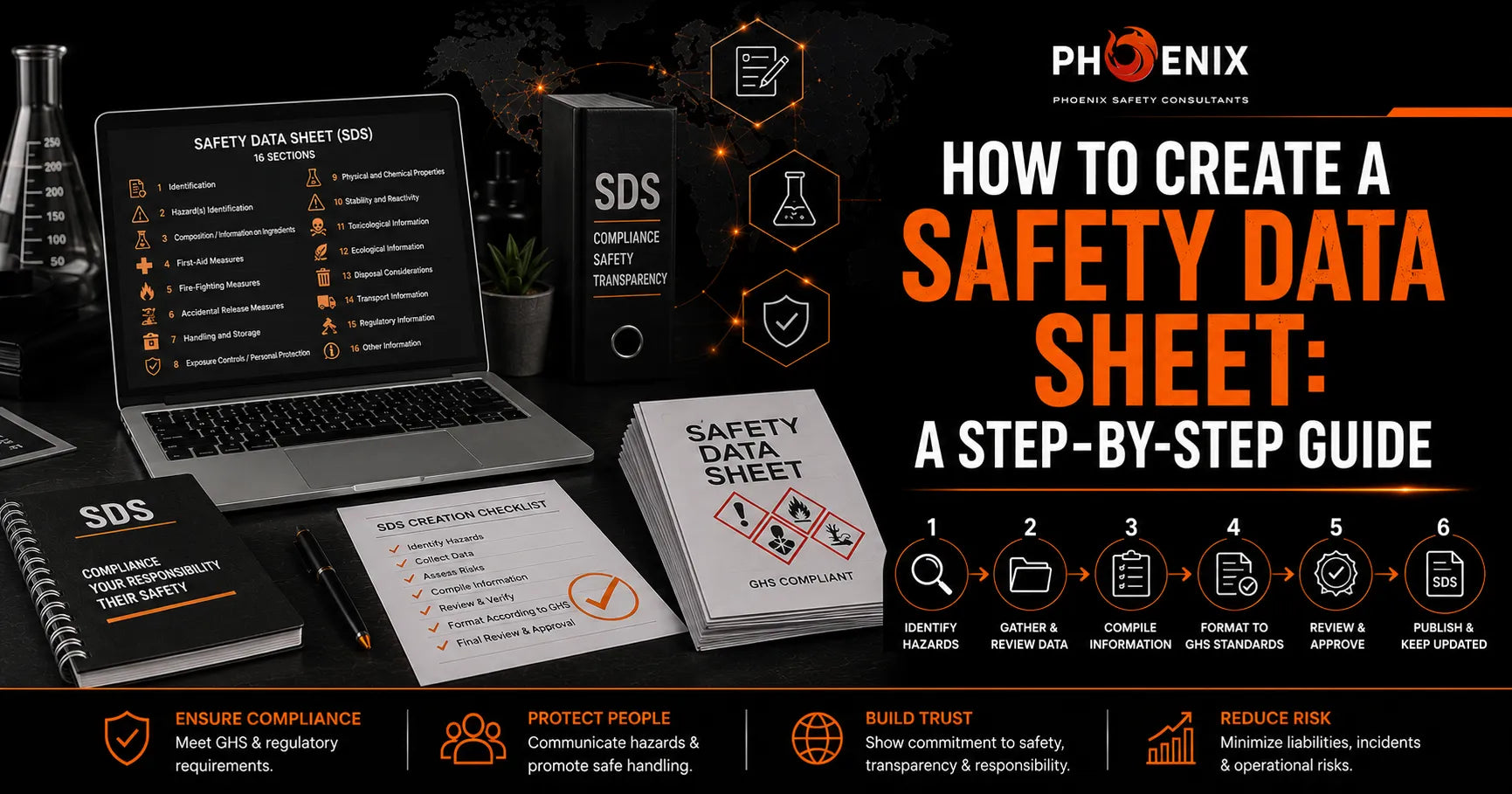
Creating an SDS follows a clear process: gather your product data, classify the hazards under GHS, work out the label elements, write the sixteen sections, add the technical and transport details, review, and date it. The writing is the easy part. The hazard classification, especially for mixtures, is where it gets genuinely difficult, and where most DIY sheets go wrong.
So this guide does two things. It gives you the full, real method for creating an SDS, and it is honest about where the hard work lives, so by the end you can decide with clear eyes whether to do it yourself or hand it to a professional.
Can You Write Your Own SDS?
There is nothing stopping you from authoring your own SDS. It is not a document that legally must come from a certified third party; the responsibility falls on whoever places the product on the market to ensure an accurate SDS exists, and that party can prepare it themselves. For a simple, single-ingredient product whose hazards are well understood and well documented, a careful person can produce a perfectly good sheet.
The caveat is that an SDS is only as good as its accuracy. A document with the wrong hazard classification is worse than useless: it can get an Amazon listing rejected, mislead the people handling your product, and expose you to liability if something goes wrong. So “can I write my own” quickly becomes “can I classify the hazards correctly,” which is a higher bar than the format alone suggests.
What You Need Before You Start
Authoring an SDS is mostly a data exercise, so gather everything below before you write a word. Missing inputs are the single biggest cause of inaccurate sheets.
Complete Composition Data
You cannot classify what you cannot see. The foundation of any SDS is the full composition: every ingredient, its chemical identity and CAS number, and its concentration or concentration range. For a product you formulate or commission, this comes from your own records or your manufacturer. Without it, you are guessing, and a guessed SDS is exactly the kind that fails review.
Physical and Test Data
You will also need the product’s physical and chemical properties, the data that fills Section 9 and underpins several hazard classes. The flash point is the big one for flammables; others include appearance, pH, boiling point, density, and solubility. Some of this comes from your formulation or supplier, and some may require testing or reliable reference data.
Product and Market Details
Finally, gather the practical details: the exact product and brand name as they will appear, on your Amazon listing, for instance, the intended use and any restrictions, the country or market the SDS is for, since that sets the regulatory framework, and any existing supplier documentation you can build from. These details shape both the content and the compliance basis of the document.
Where to Find Reliable Hazard Data
Good classification depends on good data, so it is worth knowing where to look. The most useful starting point is the ingredient-level SDS from your suppliers, which should give the hazards and CAS numbers for each component in your formulation. Beyond that, public chemical databases, such as those maintained by major regulatory and scientific bodies, provide established hazard information for individual substances, and reputable reference works can fill gaps.
The important discipline is judging the quality of what you find. Not every sheet online is accurate or current, and data written for one country may classify a substance differently than the rules you are working under. Favor authoritative, primary sources over random search results, check that the data is recent, and be cautious when sources disagree. If reliable data for a key property simply does not exist, that is a signal you may need testing, or professional help, rather than a number you are guessing at. The classification can only be as trustworthy as the data feeding it.
How to Create an SDS: Step by Step
Step 1: Gather Your Product and Ingredient Data
Start by collecting everything described above in one place: the full ingredient list with CAS numbers and concentrations, the physical data, and the product and market details. The quality of your finished SDS is capped by the quality of this input, so be thorough here before writing a single section. Incomplete data is the number-one reason DIY sheets end up wrong.
Step 2: Classify the Hazards (the Hard Part)
This is the core of the work and the step that matters most. Using the GHS rules, you determine the product’s hazard classifications: physical hazards like flammability, health hazards like skin irritation or sensitization, and environmental hazards like aquatic toxicity. For a single substance, you compare its properties against the GHS criteria. For a mixture, which most products are, you apply mixture rules, cut-off values and concentration limits, additivity formulas for hazards such as acute and aquatic toxicity, and bridging principles when you have data on similar mixtures but not the exact one. This is where genuine expertise earns its keep, and where mistakes are easiest to make.
Step 3: Determine the Label Elements
Once the hazards are classified, the label elements follow from them: the signal word (“Danger” or “Warning”), the hazard pictograms, the hazard statements (the standardized “H” phrases), and the precautionary statements (the “P” phrases). These are not freely written; they are prescribed by the classification, so this step is largely about correctly mapping your hazards to the right standardized elements rather than inventing wording.
Step 4: Write the 16 Sections
Now you write the document itself, all sixteen sections in order, from identification through to other information. Much of this is structured and, with the classification done, relatively mechanical: filling in identity, first-aid, fire-fighting, handling, storage, and so on with accurate, product-specific content. The key is that every section is genuinely completed, not left blank or padded with generic boilerplate that does not actually fit your product.
Step 5: Add the Physical and Transport Data
Populate Section 9 with the physical and chemical properties you gathered, taking particular care with the flash point and anything else that supports your hazard classification. Then complete Section 14, transport information, with the correct UN number, proper shipping name, and hazard class if your product is a dangerous good, this is essential for anything flammable or battery-related. These two sections carry the data that marketplaces and shippers scrutinize most closely.
Step 6: Review for Accuracy and Consistency
Before you rely on the document, review it for accuracy and internal consistency. Do the hazards in Section 2 match the ingredients in Section 3 and the properties in Section 9? Does the transport classification in Section 14 align with the hazards? Does the product name match your listing? An SDS that contradicts itself is a red flag, and inconsistencies are a common reason for rejection. Reading it as a whole, rather than section by section in isolation, is what catches these.
Step 7: Date, Version, and Finalize
Finally, record the revision date and a version number in Section 16, and finalize the document as a clean, legible PDF. The date is what everyone uses to judge currency, so it must be present. Keep your source data and the final file together, so that when you need to update the sheet later, you are not starting from scratch.
The Hard Part: Why Hazard Classification Trips People Up
It is worth dwelling on why classification is the real challenge, because it is easy to underestimate. Classifying a single, well-studied chemical can be a matter of looking up its established hazards. But most products are mixtures, and mixtures are not classified by simply copying their ingredients’ hazards. You have to apply the GHS mixture rules: some hazards depend on whether an ingredient exceeds a concentration cut-off; others, like acute and aquatic toxicity, use additivity formulas that combine the contributions of multiple ingredients; and where you lack data on the exact mixture, bridging principles let you reason from similar ones, within strict limits.
Get any of this wrong and the whole document is wrong, often in ways that are not obvious to a non-specialist. A product can look harmless and be a flammable liquid; an ingredient just under a concentration threshold might not trigger a classification while the same ingredient just over it does. This is precisely why a sheet that looks complete can still be inaccurate, and why classification, not formatting, is the line between a DIY SDS that works and one that quietly fails.
Should You Use an SDS Template?
A natural shortcut is to grab an SDS template and fill in the blanks. Templates are useful for one thing: they give you the correct sixteen-section structure so you do not miss a section. What they cannot give you is the classification, the actual determination of your product’s hazards, which is the hard, product-specific work. A template hands you an empty frame; it does not tell you what belongs in it for your formulation.
The danger is that a filled-in template looks like a finished SDS, which can give false confidence. If the hazard classification behind it is wrong, a tidy template just makes a wrong document look professional. Use a template for structure if you like, but never mistake completing one for having correctly classified your product.
DIY vs. Hiring a Professional: How to Decide
So how do you decide? It comes down to the complexity of your product, the quality of your data, what is at stake, and how comfortable you are with GHS classification. The table below is a rough guide:
|
Factor |
DIY may be fine |
Get professional help |
|
Product |
Single, well-understood substance |
Complex mixture or many ingredients |
|
Hazard data |
Clear and available; you can interpret it |
Uncertain or borderline classification |
|
What's at stake |
Low-volume or internal use |
Amazon listing, shipping, or liability |
|
Time |
You have time to learn the rules |
A tight deadline, like Amazon’s 14 days |
|
GHS confidence |
Comfortable classifying mixtures |
Unsure how classification works |
As a rule of thumb: if your product is a single, well-understood substance and you have time and clear data, doing it yourself can work. If it is a mixture, the classification is uncertain, money or a deadline is on the line, or you are not confident applying the GHS rules, the cost of a professional is small next to the cost of getting it wrong.
Common Mistakes When Writing Your Own SDS
If you do take the DIY route, steer clear of the errors that most often produce a failing sheet:
- Skipping straight to writing without first gathering complete composition data.
- Copying ingredient hazards into the sheet without applying the GHS mixture rules.
- Leaving the flash point or other key data blank in Section 9.
- Treating a filled-in template as a finished SDS, when the classification behind it was never done properly.
- Writing for the wrong country, or failing to match the product and brand name to your listing.
- Forgetting the revision date in Section 16, which makes the document read as incomplete.
How to Check Your Finished SDS
Before you submit or rely on the document, run it through a final quality check:
- All sixteen sections are present and in the correct order.
- The hazard classification in Section 2 is consistent with the ingredients (Section 3) and properties (Section 9).
- The flash point and other key physical data are filled in.
- The transport details in Section 14 are correct for a dangerous good, if your product is one.
- The regulatory information in Section 15 is written for the right country.
- The product and brand name match your listing exactly.
- There is a clear revision date and version in Section 16.
- The whole document is legible and free of leftover template placeholders.
How to Keep Your SDS Compliant After You Create It
Creating the SDS is not quite the end of the job. Once it exists, it has to stay accurate, which means revisiting it whenever your formulation changes, when new hazard information emerges, or when the underlying regulations are revised, and reviewing it periodically even if nothing obvious has changed. Marketplaces and shippers also expect a reasonably recent revision date, so a sheet that sits untouched for years can fall out of acceptance even while your product stays the same.
Plan for this from the start. Keep your source data and the finished file together, note when the next review is due, and treat an update as a small, scheduled task rather than an emergency. A document you created carefully and then maintain is an asset that keeps clearing reviews; one you create once and forget tends to resurface as a problem at the worst possible moment.
| Rather not gamble your listing on the classification step? We author complete, US OSHA-compliant Safety Data Sheets from your product data, with the hazards classified correctly and matched to your listing, and 24-hour rush available. You bring the ingredients; we handle the hard part. |
Frequently Asked Questions
Can I legally write my own SDS?
Yes. There is no requirement that an SDS come from a certified third party. The responsibility is on whoever markets the product to ensure an accurate SDS exists, and you can prepare it yourself, as long as it is correct. Accuracy, not authorship, is what matters.
Is there a free SDS template I can use?
Templates exist and can give you the correct 16-section structure, but they only provide the frame, not the hazard classification, which is the difficult, product-specific work. A filled-in template is not the same as a correctly classified SDS.
What is the hardest part of creating an SDS?
The hazard classification, especially for mixtures. Combining ingredients’ hazards using GHS cut-off values, additivity formulas, and bridging principles takes real expertise, and it is where most DIY sheets go wrong.
How long does it take to write an SDS?
It varies widely. A simple, single-substance product can be done in a few hours if you already understand GHS classification. A complex mixture takes much longer. Professional services typically deliver in a few business days, or within 24 hours on a rush basis.
Do I need lab testing to create an SDS?
Sometimes. Physical data like the flash point may require testing if it is not otherwise available, but in many cases you can rely on supplier data or reliable reference sources. The need for testing depends on the product and the data you already have.
Where can I get the hazard data to classify my product?
Start with the ingredient SDS from your suppliers, which give each component’s hazards and CAS numbers, then supplement with authoritative chemical databases and reputable references. Favor primary, current sources, and be wary of random results online, since inaccurate or wrong-country data leads to wrong classifications.
When should I hire someone instead of doing it myself?
When your product is a mixture, the classification is uncertain or borderline, real money or a deadline is on the line, or you are not confident applying the GHS rules. In those cases the cost of professional authoring is small compared with a rejected listing or a misclassified hazard.
The Bottom Line
Creating a Safety Data Sheet is a defined process, gather your data, classify the hazards, derive the label elements, write the sixteen sections, add the technical and transport details, review, and date it. None of those steps are mysterious, and for a simple product a careful author can do them all. The honest truth is just that one step, hazard classification, carries almost all the difficulty and almost all the risk, because an SDS that is well formatted but wrongly classified is a liability dressed up as compliance.
So decide based on your product, not on the price tag alone. If it is simple and you have the data and the time, follow this guide and check your work carefully. If it is a mixture, the stakes are real, or the classification is beyond your comfort zone, get it authored properly. Either way, the goal is the same: a document that is accurate, not just complete.
Want the classification done right the first time? Get your SDS authored here or send us your product details — we’ll handle the hard part and match it to your listing.